Key Points
- A cataract is the clouding of the eye’s natural lens, a common, age-related condition that causes vision problems like blurry vision, glare/halos, poor night vision, and fading colors.
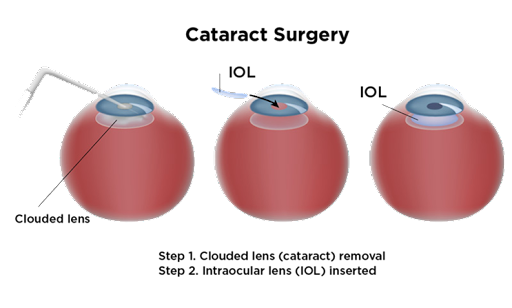
- Cataract surgery involves removing the cloudy lens and replacing it with a new, clear, artificial Intraocular Lens (IOL).
- Traditional cataract surgery uses a basic monofocal IOL (covered by OHIP), which is designed to correct vision for only one distance, meaning patients will still need to wear glasses for other tasks (like reading).
- Traditional cataract surgery is performed using ultrasound energy to safely remove the old lens. Additionally, an ultrasound test (A-Scan) is performed to determine the power of the new IOL.
- Patients that have been diagnosed with a cataract can be referred to Herzig Eye Institute in Toronto or Ottawa for a cataract consultation, which is covered by OHIP.
- During a cataract consultation at Herzig Eye Institute, patients will meet with a surgeon and undergo diagnostic tests, including a comprehensive lifestyle assessment. Patients will learn about their options for cataract surgery to help them achieve their vision goals.
Traditional Cataract Surgery
Our goal at Herzig Eye Institute for every patient having cataract surgery is to achieve their best possible vision. Most of our patients want to eliminate or significantly reduce their dependence on glasses after their cataract surgery. Some patients are happy to continue wearing glasses and can proceed with traditional cataract surgery, which is covered by OHIP in the province of Ontario.
What is a Cataract and How is it Treated?
A cataract is when the eye’s natural lens clouds, leading to vision problems. Everyone, if they live long enough, will develop cataracts.
Cataracts are the most common cause of vision loss for people all around the world. Cataracts are a natural part of the aging process, but they do not have to interfere with your lifestyle. In order to diagnose a cataract, a thorough eye exam is needed. Once a cataract is detected, treatment options can be discussed.
Modern cataract surgery is performed using ultrasound energy. An ophthalmologist replaces the eye’s old, cloudy, or discoloured lens with a new, acrylic or silicone intraocular lens (IOL). The most common IOL for cataract surgery is a monofocal lens. It is designed to correct vision at one distance.
What’s the difference between manual cataract surgery and precision refractive cataract surgery?
We offer all cataract patients multiple options during their comprehensive consultation. The first is to have traditional cataract surgery performed by a Herzig Eye Institute surgeon, which is covered by OHIP. Traditional cataract surgery includes an OHIP covered intraocular lens (IOL) and an ultrasound test (A-Scan) to determine the power of the IOL to be inserted in your eye. Patients will need to wear glasses after traditional cataract surgery.
For patients looking to eliminate or significantly reduce the need for glasses post-operatively, we offer Precision Refractive Cataract Surgery, which is the most advanced level of cataract surgery available. When refractive surgery is combined with cataract surgery, it consists of specialized technologies, advanced IOLs, and diagnostic tests that are not covered under OHIP.
Herzig Eye Institute also offers Laser Assisted Cataract Surgery with the Catalys® laser combines a state-of-the-art femtosecond laser and advanced 3D Optical Coherence Tomography (OCT) imaging to complete many of the critical steps of surgery that are traditionally done manually with handheld instruments. Using a laser to complete these steps prior to removing the cataract adds an element of precision, softens the cataract to make the surgery a little gentler on the eye, and helps with the correction of astigmatism.
CATARACT SYMPTOMS
- Clouded or blurry vision
- Difficulty seeing at night
- Halos around lights
- Light sensitivity
- Seeing double
- Colours fading or yellowing
- Prescription changes
CATARACT SYMPTOM CHECKER
Want to learn more about Cataract Surgery?
Download The Complete Guide to Cataract Solutions





 +1 (647) 490-6509
 416.929.0232